

Microsoft Adopts Ontology-Based IQ Layer for Agentic AI
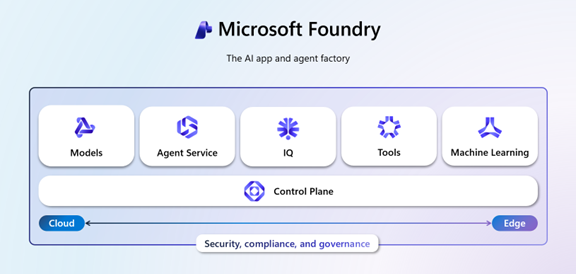
Image 漏 Microsoft
Source: , Microsoft, 16 Dec. 2025
At Microsoft announced several major offerings strengthening its agentic AI platform. The ontology-based IQ layer seems to be the most unexpected innovation from Microsoft. It was unexpected because Microsoft has never used the term 鈥渙ntology鈥� before. Microsoft Graph in Office 365 was not built on the . The semantic layer for AI was first commercially built for IBM Watson around 2011. Then, the research (along with the main researcher ) moved to Google Labs. until recently, when the company from proprietary technologies to interoperability-enabling open standards.
and were quite expected: Foundry facilitates building AI agents on a unified and interoperable platform, while Agent 365 provides the control plane to manage and secure AI agents 鈥� both are indispensable for an agentic AI platform, and similar tools are offered by other vendors. Microsoft, having brandished only Azure OpenAI until recently, now makes over 11,000 models available for use in Foundry.
The IQ layer that includes , , and differentiates Microsoft from the competition. While and with the intent of using the semantic capabilities of the acquired companies to train and govern AI agents, Microsoft went much further: the IQ stack provides holistic semantic integration across:
- Microsoft 365, including SharePoint, Teams, etc. (Work IQ)
- MS Fabric, including OneLake, SQL on Fabric, etc. (Fabric IQ)
- AI Foundry hosting 11K+ AI models (Foundry IQ)
Additionally: the Semantic Ontology Standard used to build the MS IQ stack enables:
- Hierarchical knowledge representation
- Definition of concepts as classes with class-specific attribution
- Class-specific constraints that define logical interactions across classes
The above will be extremely important for training and grounding AI agents in a given organizational environment. It also exponentially increases the accuracy and predictability of AI models while enabling them to process structured and unstructured data across Office 365, SQL, and OneLake coherently.
that typically leaves organizations with fragmented, duplicated pipelines all trying to answer the same question: what context does the model need to respond effectively? Now instead of wiring retrieval logic into every agent, a reusable knowledge base is defined, and Foundry IQ handles indexing, vectorization, query planning, and multisource routing.
to:
- Define enterprise concepts (like Customer, Shipment, and Breach) one time, and generate or align Power BI models so KPIs remain consistent across reports (in ontology).
- Declare which things connect and why (in ontology) as well as store and compute traversals, like "Find shipments exposed to risky routes and related breaches" (in graph).
- Ground agents in shared business semantics and rules so they can retrieve relevant context, reason across domains, and recommend or trigger governed actions.
In other words, ontology defines the language for your business, digital twin builder makes it operational for assets, graph powers dependency/impact analysis, and semantic models present trusted KPIs.
by:
- Enabling Agent Mode in each Office Application (Word, Excel, PowerPoint).
- Getting all the rich knowledge from emails, files, meetings, and chats.
- Combining data and memory to make valuable connections, unlock insights, and predict the next best action 鈥� going far beyond what connectors can do.
Our Take
The ontology-based IQ layer for agentic AI is a groundbreaking move by Microsoft. It opens the door to enforce behavioral governance over the AI agents as governance rules can be specified as part of the ontology. Simply explained: Ontology enables creation and enforcement of policies for AI agents, similar to the policies that are written for and enforced among human employees.
It enables consistent analytics across Office, OneLake, and SQL data.
It minimizes chances for AI agents to hallucinate or act out of logical sync with one another, thus reducing a major barrier to AI adoption and success.
Microsoft provides as part of Fabric鈥檚 environment. Those tools, however, look quite usable by developers and data engineers but not quite by business users. ServiceNow will use data.world鈥檚 business user-friendly interface to build and manage both the ontology and the graph. Hopefully, by the time ontology moves from Public Preview into GA, Microsoft will improve the UX of these tools, which should not be a big problem. Ideally, the tool should have its own ontology-building AI agent to make the process faster and less strenuous for organizations.