
Future-Proof Your Warehouse Operations With Modern Warehouse Management Systems
Use technology to unlock the potential of your warehouses.
Disconnected systems hinder decision-making. Without tight integration between WMS and systems like ERP, MES, and TMS, manufacturers face data silos and delays, leading to poor coordination across production, warehousing, and shipping.
Lack of visibility causes planning failures. When inventory data isn鈥檛 current or accurate, it leads to stockouts, overproduction, or delayed fulfillment 鈥� disrupting manufacturing flow and customer commitments.
Managing multiple sites is operationally inconsistent. With varying workflows, compliance rules, and visibility levels, global manufacturers face high IT complexity, data fragmentation, and inefficiencies across sites.
Our Advice
Critical Insight
CIOs must be deliberate in defining the organizational needs that drive their WMS transformation. Attempting to prioritize modernization for the sake of modernization will dilute impact, yet doing nothing under the guise of cost containment will leave you vulnerable. CIOs must build a roadmap that accounts for clear trade-offs and focused sequencing in line with what the business wants to achieve and overall resilience.
Impact and Result
A detailed methodology to prioritize business requirements for WMS solution selection.
About Info-Tech
91制片厂 is the world鈥檚 fastest-growing information technology research and advisory company, proudly serving over 30,000 IT professionals.
We produce unbiased and highly relevant research to help CIOs and IT leaders make strategic, timely, and well-informed decisions. We partner closely with IT teams to provide everything they need, from actionable tools to analyst guidance, ensuring they deliver measurable results for their organizations.
What Is a Blueprint?
A blueprint is designed to be a roadmap, containing a methodology and the tools and templates you need to solve your IT problems.
Each blueprint can be accompanied by a Guided Implementation that provides you access to our world-class analysts to help you get through the project.
Need Extra Help?
Speak With An Analyst
Get the help you need in this 5-phase advisory process. You'll receive 8 touchpoints with our researchers, all included in your membership.
Guided Implementation 1: Establish Your Current State
- Call 1: Conduct current-state and IT satisfaction surveys.
- Call 2: Document requirements and objectives.
Guided Implementation 2: Assess Capability Maturity and Satisfaction
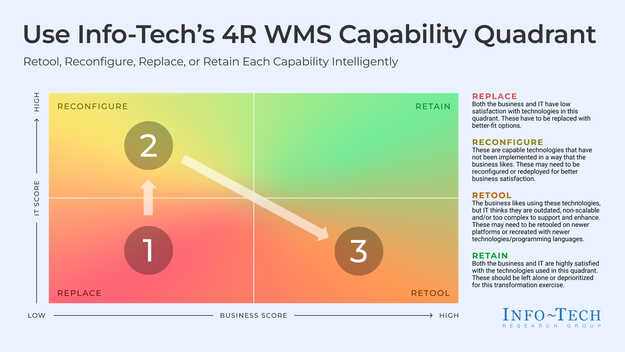
- Call 1: Review heat map and capability quadrant to identify focus areas.
Guided Implementation 3: Analyze Gaps and Prioritize Needs
- Call 1: Understand potential improvement actions.
- Call 2: Document planned IT improvement actions.
Guided Implementation 4: Define Actions and Opportunities
- Call 1: Discuss and confirm implementation considerations.
Guided Implementation 5: Design Modernization Roadmap
- Call 1: Discuss initiative prioritization.
- Call 2: Review and finalize roadmap.
Contributors
- Jasmine Choi, Komstadt Systems
- Christopher Micena, EVS
- Evan McGrath, EVS
- Nivedha Ganesh, DHL
- Steve Schmidt, Senior Managing Partner, 91制片厂
- 2 Anonymous contributors