
Fast-Track Your Enterprise Service Design
Design a sustainable enterprise service customers want to use, employees want to support, and the organization wants to finance.
IT has a unique ability to see connections across the organization and how information flows through its systems. That makes IT ideally positioned to lead service design 鈥� but it鈥檚 often brought into the process far too late. To take the lead on this from the beginning, IT must adopt a 鈥渟ervice-first鈥� mindset. With our step-by-step guide, IT leaders can design coherent, sustainable services that fully meet the needs of their organization, employees, and customers.
Digitization is not transformation. Simply digitizing services loses sight of what customers really want, frustrates employees who must support and deliver the service and wastes your 辞谤驳补苍颈锄补迟颈辞苍鈥檚 precious resources. Don鈥檛 just digitize enterprise services 鈥� design them to ensure they deliver value. Learn how IT can make that critical shift and evolve from technology provider to enterprise service orchestrator.
1. Avoid disastrous, short-sighted design investments.
Fully assess before you invest; clearly define your service鈥檚 context and scope. Start by gaining an understanding of the problem your service solves, the resources it requires, and the stakeholders needed to build, operate, and improve it. If you spend just enough time on this upfront, you鈥檒l avoid making a disastrous investment in the wrong services.
2. Don鈥檛 let the customer鈥檚 voice get lost.
Whatever service you鈥檙e creating, the approach is the same: design your service around the customer鈥檚 journey, needs, and experiences. While stakeholder value is important, customer-centricity should be the focal point of your service design.
3. Identify and align key skills, technology, and processes.
Enterprise services don鈥檛 operate in a vacuum; they can鈥檛 service and support customers without the proper mix of skills, processes, and technology in place. Be sure to incorporate those crucial elements into your service design accordingly.
4. Embrace reusability for faster, better design.
Identify existing components, skills, and processes that are already effective in your organization, then reuse them wherever possible in new service design. This reduces waste, saves money, and speeds up delivery time. Keep the ball rolling by designing brand new components with future reuse in mind.
Use this actionable blueprint to design and orchestrate enterprise services, not just digitize them.
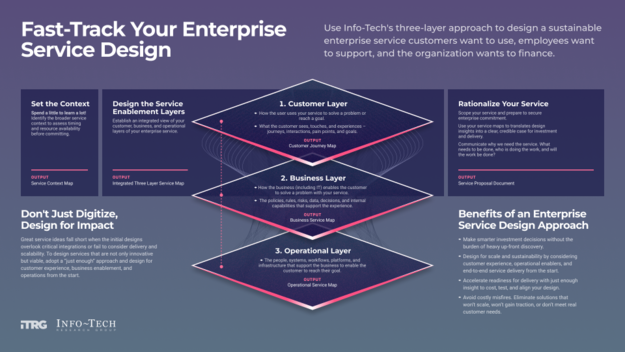
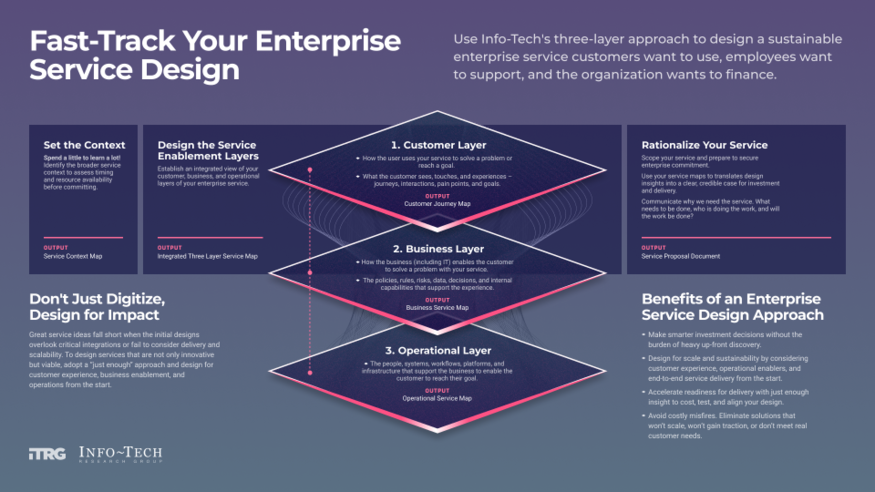
Follow our three-layer service design framework to create resilient, efficient enterprise services.
- Design services to solve real customer problems based on what the customer sees, touches, experiences, and interacts with, including their goals and pain points.
- Achieve enterprise-wide sustainability by aligning service design with the 辞谤驳补苍颈锄补迟颈辞苍鈥檚 goals, roles, processes, rules, risks, data, decisions, and internal capabilities.
- 91制片厂 sustainable systems at the operational level by incorporating the people, workflows, platforms, and infrastructure that support the organization in enabling the customer to reach their goal.
About Info-Tech
91制片厂 is the world鈥檚 fastest-growing information technology research and advisory company, proudly serving over 30,000 IT professionals.
We produce unbiased and highly relevant research to help CIOs and IT leaders make strategic, timely, and well-informed decisions. We partner closely with IT teams to provide everything they need, from actionable tools to analyst guidance, ensuring they deliver measurable results for their organizations.
What Is a Blueprint?
A blueprint is designed to be a roadmap, containing a methodology and the tools and templates you need to solve your IT problems.
Each blueprint can be accompanied by a Guided Implementation that provides you access to our world-class analysts to help you get through the project.
Need Extra Help?
Speak With An Analyst
Get the help you need in this 5-phase advisory process. You'll receive 16 touchpoints with our researchers, all included in your membership.
Guided Implementation 1: Define Your Service鈥檚 Context and Scope
- Call 1: Scope requirements, objectives, and your specific challenges.
- Call 2: Describe the service.
- Call 3: Service鈥檚 wider context & service viability.
Guided Implementation 2: Discover the Customer Layer
- Call 1: Service stages & persona.
- Call 2: Customer goals and activities.
- Call 3: Customer questions, touchpoints, and emotions.
- Call 4: Discuss opportunities.
Guided Implementation 3: Identify the Business Layer
- Call 1: Business goals, activities, and roles.
- Call 2: IT goals, activities, and roles.
- Call 3: Desired outcomes and associated risks.
Guided Implementation 4: Identify the Operational Layer
- Call 1: Business goals, activities, and roles.
- Call 2: IT goals, activities, and roles.
- Call 3: Desired outcomes and associated risks.
Guided Implementation 5: Analyze, Finalize, and Communicate
- Call 1: Key abilities.
- Call 2: Key technical systems.
- Call 3: Revisit design and context and complete proposal document.
Contributors
- Trevor Banks, Manager, Digital Organisational Design, The Treasury Board of Canada Secretariat
- Isa David, Director, Digital Talent Development, The Treasury Board of Canada Secretariat
- Thomas Kearney, Senior Analyst, Digital Organisational Design, The Treasury Board of Canada Secretariat
- Liz McKeown, Director General, Digital Community Management, The Treasury Board of Canada Secretariat
- Stefany Singh, Chief Digital Officer, BC Energy Regulator (BCER)
- Lily Yan, Director, Business Process Architecture, PointClickCare
 鈥嬧�婥reate a Service Management and IT Operations Strategy鈥�
 Develop a Plan to Pilot Enterprise Service Management
 Create a Service Management Roadmap
 Elevate Your Service Capabilities to Drive Enterprise Value
 Design and 91制片厂 a User-Facing Service Catalog
 Create an IT View of the Service Catalog
 Initiate Your Service Management Program
 Develop Meaningful Service Metrics
 IT Service Management Selection Guide
 Service Management Integration With Agile Practices
 Define Your Enterprise IT and Digital Services
 Fast-Track Your Enterprise Service Design