
Identify and Respond to Credible Threats Arising From Global Uncertainty
Proactively manage the impact of macro uncertainties on your organization.
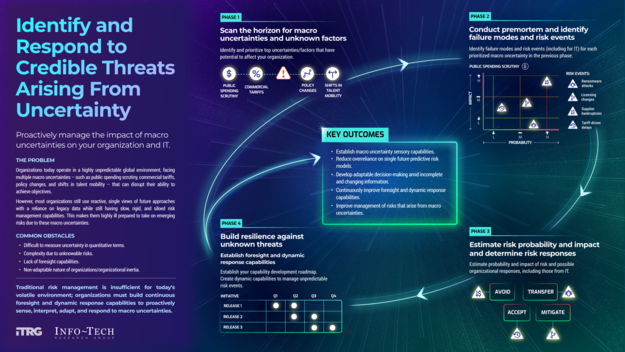
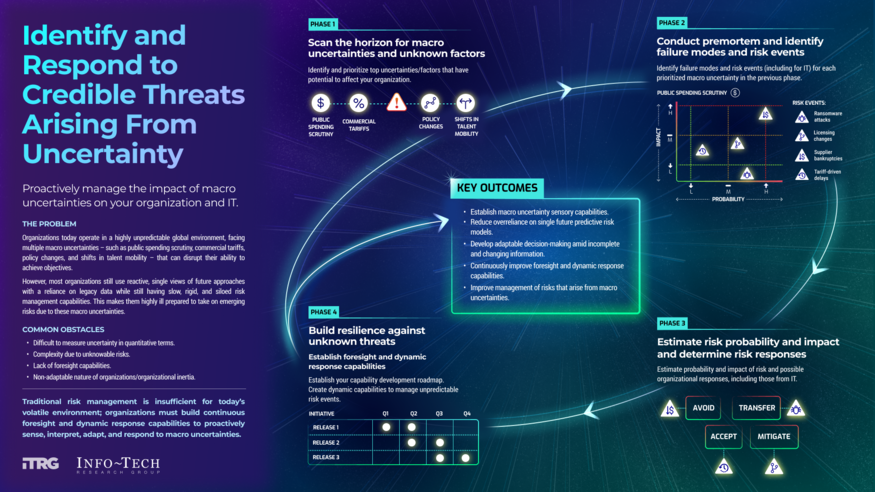
Traditional risk programs are no match for today鈥檚 macro-level volatility and uncertainty. New and unknowable threats are emerging from weak signals, rippling across systems, and demanding quick responses even with incomplete data. Rather than rely on single-future risk models, organizations must broaden their outlook to more flexible multi-future ones. Use this step-by-step framework to evolve your entire organization鈥檚 relationship with uncertainty to a dynamic approach that can adapt and respond quickly as conditions change.
Organizations must move beyond reactive mitigation, embedding proactive risk detection, management, and mitigation into their DNA 鈥� and leaders across multiple disciplines must become comfortable with acting on limited information. By embracing this dynamic approach, organizations can move from fearing uncertainty to dancing with it, leaving them nimble and future-ready in the face of both certain and unforeseeable risks.
1. A single-future outlook can blind your strategy.
Organizations that treat uncertainty as something to be modeled and managed like traditional risk are setting themselves up to be blindsided. Overreliance on single-future scenarios discourages constructive dissent, overlooks weak signals, and instills false confidence, making it harder to respond to changing circumstances. Foresight demands more than data 鈥� it requires the ability to plan when data is scarce and pivot when needed.
2. Readiness requires more than reaction.
When it comes to uncertainty, most organizations are still trapped in reactive cycles, treating disruption as an exception rather than an expectation. 91制片厂ing continuous foresight means embedding early sensing, operational awareness, and dynamic response into working practices across the organization and its technology.
3. Agility before accuracy.
Perfect understanding is a luxury. IT leaders must nurture the ability to make confident decisions amid ambiguity. When new information surfaces, organizations must then be ready to reframe, revise, and redirect without hesitation 鈥� success now depends less on certainty and more on adaptability.
Use this step-by-step research to overcome uncertainty with a proactive strategy
Our research provides tools and examples to help you identify the risks and responses needed to deal with macro-uncertainties as well as the capabilities and roles your organization will need to be more proactive and dynamic. Use this step-by-step approach to strengthen your organization鈥檚 ability to evaluate emerging threats, uncover root causes of failure, and respond to uncertainty in real-time.
- Scan the horizon for macro uncertainties to identify those with the most potential to affect your organization.
- Conduct a premortem exercise to identify the failure scenarios and risk events that matter most.
- Identify risk events, probability, and impact to chart out possible responses across various organizational units, including IT.
- Develop your key capabilities roadmap to close gaps and identify areas of improvement to foster a dynamic and integrated risk response.
About Info-Tech
91制片厂 is the world鈥檚 fastest-growing information technology research and advisory company, proudly serving over 30,000 IT professionals.
We produce unbiased and highly relevant research to help CIOs and IT leaders make strategic, timely, and well-informed decisions. We partner closely with IT teams to provide everything they need, from actionable tools to analyst guidance, ensuring they deliver measurable results for their organizations.
What Is a Blueprint?
A blueprint is designed to be a roadmap, containing a methodology and the tools and templates you need to solve your IT problems.
Each blueprint can be accompanied by a Guided Implementation that provides you access to our world-class analysts to help you get through the project.
Need Extra Help?
Speak With An Analyst
Get the help you need in this 1-phase advisory process. You'll receive 10 touchpoints with our researchers, all included in your membership.
- Call 1: Scope requirements, objectives, and your specific challenges.
- Call 2: Conduct horizon scanning.
- Call 3: Evaluate impact on industry and organization.
- Call 4: Prioritize trends and factors.
- Call 5: Conduct a premortem to identify failure modes.
- Call 6: Identify risk events.
- Call 7: Set risk scales and add risk impact and probability estimates.
- Call 8: Document risk responses.
- Call 9: Evaluate current state of foresight and dynamic capabilities.
- Call 10: Develop capabilities improvement map.
Contributors
2 anonymous contributors
 Optimize IT Governance for Dynamic Decision-Making
 Maximize Business Value From IT Through Benefits Realization
 91制片厂 an IT Risk Management Program
 Review and Improve Your IT Policy Library
 Establish a Sustainable ESG Reporting Program
 Take Control of Compliance Improvement to Conquer Every Audit
 91制片厂 an Effective IT Controls Register
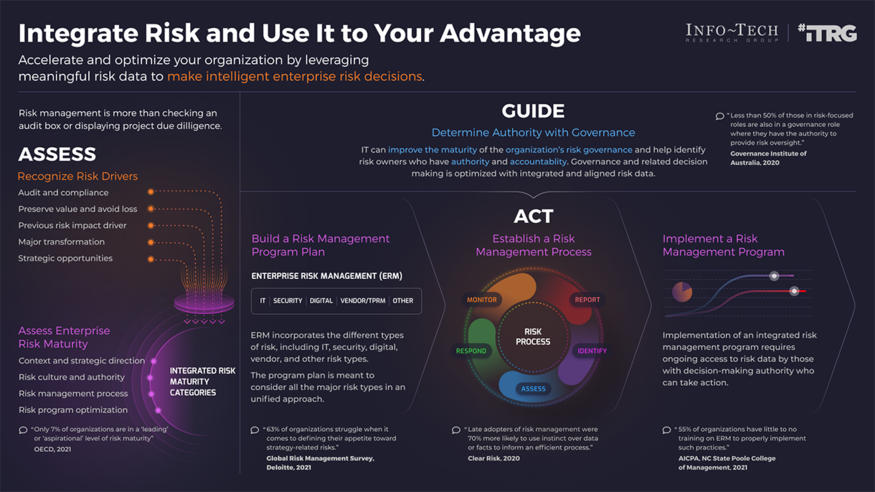
 Integrate IT Risk Into Enterprise Risk
 The ESG Imperative and Its Impact on Organizations
 Make Your IT Governance Adaptable
 91制片厂 an IT Risk Taxonomy
 Prepare for AI Regulation
 91制片厂ing the Road to Governing Digital Intelligence
 Identify and Respond to Credible Threats Arising From Global Uncertainty